Treatment for the Sting of the Red Imported Fire Ant
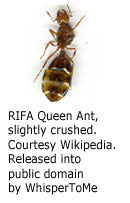
Solenopsis invicta
Should you experience the misfortune of an attack by Red Imported Fire Ants, or RIFA - typically after unwittingly disturbing a nest - you can expect to endure itching and burning, redness, swelling, blistering, postules and perhaps serious infections from the dozens to hundreds of stings. If you are among the few who are particularly sensitive to the ant's venom, you might even suffer the life-threatening allergic response called "anaphylaxis," a condition that requires emergency medical care.
If Possible, Avoid the Ants or Minimize Stinging
 First, if possible, steer clear of RIFA nest mounds, which may
harbor hundreds of thousands of the ants. Typically, the mounds are characterized
by a several-inch-high and 12- to 18-inch-wide symmetrical pile of loose soil
without the central opening typical of most ant nests. Most often, you will find
them in open fields, but you may also find RIFA nests sequestered within crevices
or openings in and around your home.
First, if possible, steer clear of RIFA nest mounds, which may
harbor hundreds of thousands of the ants. Typically, the mounds are characterized
by a several-inch-high and 12- to 18-inch-wide symmetrical pile of loose soil
without the central opening typical of most ant nests. Most often, you will find
them in open fields, but you may also find RIFA nests sequestered within crevices
or openings in and around your home.
If you have to work in the vicinity of RIFA nests, cover your skin and clothing with an insect repellent, which will help discourage an approach by the insects. Wear rubber boots and gloves powdered with talc or baby powder, which helps suffocate ants that might crawl onto your legs and arms.
If ants still manage to reach and attack your legs and arms, latching onto your skin with their mandibles, brush them off as quickly as possible with a cloth or handkerchief. If you can remove the ants promptly, before they inject their venom, you can prevent the formation of postules.
Sting Treatment
If you experience a relatively mild attack, with relatively few stings:
- Wash the area as quickly as possible with antiseptic soap.
- Further sterilize the area with alcohol.
- If you do not have a commercial preparation or medication immediately available, apply ice judicially or a baking-soda-and-water paste to help relieve the itching and burning.
- If available, apply topical corticosteroids or use a nonseditive antihistamine - carefully following the instructions on the label - to relieve the itching and burning.
- You may find longer-term relief in specially formulated commercial products such as: Wipe Away Pain Fire Ant Sting Medicated First Aid Gel, Re-Leaf with aloe for Fire Ant Bites Pain Relief Gel, Organic Plus Sting Out, Mitigato Sting and Bite Treatment and Campho Phenique. Again, follow the directions on the label.
- Remember that many home remedies, for instance, meat tenderizers, may do more harm than good.
- During any treatment, take special care to avoid causing postules to rupture, which may open the way for invasion of bacteria and subsequent infection and scarring.
If you experience a severe RIFA attack, with multiple stings, sterilize the area and, to the extent possible, treat the itching and burning, but consult a doctor promptly for treatment. If you experience anaphylaxis symptoms - falling blood pressure, vomiting, diarrhea, swelling, facial puffiness, severe sweating, wheezing, hives and slurred speech - call for emergency medical help. Remember that if you have diabetes or a circulatory disorder, you may be at greater risk for complications.
Common Questions About Red Imported Fire Ants
- How do I recognize an imported red fire ant?
- Is an imported red fire ant’s sting venomous?
- What should I do if I’m stung
by an imported red fire ant?
- How can I keep imported red fire ants out of my house and yard?
- What are the native species of red fire ants of the Southwest?
- Health and Medical Disclaimer
Useful Sources
Texas A&M University Internet site, Fire Ant Plan Fact Sheet #023, Bastiaan
M. Drees
The Best Control, Stephen Tvedten
L. E. Gilbert, University of Texas at Austin Internet site
The information provided on this web site and by this web site through content provided by Authors or third party providers, and in other sources to which it refers, is PROVIDED FOR INFORMATIONAL PURPOSES ONLY and should not be used to diagnose or treat a health problem or disease.
Information provided at and by DesertUSA is NOT A SUBSTITUTE FOR PROFESSIONAL MEDICAL CARE. If you have a medical concern, or suspect you have a health problem you should consult your primary doctor or specialist.
If you cannot agree to this Health and Medical Disclaimer, you are not permitted to use this web site and should exit immediately.
Related DesertUSA Pages
- How to Turn Your Smartphone into a Survival Tool
- 26 Tips for Surviving in the Desert
- Death by GPS
- 7 Smartphone Apps to Improve Your Camping Experience
- Maps Parks and More
- Desert Survival Skills
- How to Keep Ice Cold in the Desert
- Desert Rocks, Minerals & Geology Index
- Preparing an Emergency Survival Kit


Share this page on Facebook:
The Desert Environment
The North American Deserts
Desert Geological Terms


