Red Imported Fire Ants
Solenopsis invicta
Common Questions About Red Imported Fire Ants
- How do I recognize an imported red fire ant?
- Is an imported red fire ant’s sting venomous?
- What should I do if I’m stung
by an imported red fire ant?
- How can I keep imported red fire ants out of my house and yard?
- What are the native species of red fire ants of the Southwest?
- Health and Medical Disclaimer
 The red imported fire ant, or "RIFA" - an invasive species from
the lowlands of Brazil - has now staked a claim in the Southwest. Typically
more tenacious and aggressive than our native fire ants, it entered the United
States through the port of Mobile, Alabama in the 1930s. Subsequently, the red
fire ants expanded into the 11 southeastern states. In the 1990's, it moved westward,
traveling aboard trucks, trains and trailers with infested cargoes such as sod,
plants, compost and used farm equipment. The ant has made appearances in Arizona
and far western Texas, and it has gained solid footholds in southern California
and south central New Mexico, establishing itself in residential areas, farmlands,
rangelands and wilderness areas.
Description of a Red Imported Fire Ant
- One eighth- to one quarter-inch-long
- Body is red to brown in color with a black gaster (posterior portion of the abdomen).
- The red fire ant has a body with three segments: head, thorax and abdomen.
- Compound eyes for detecting images and light
- Two powerful mandibles for biting, cutting, digging and carrying
- A mouth for eating and cleaning
- Two sensitive ten-segmented antennae for touching, tasting, smelling and ant-to-ant communication
- Thorax contains densely packed muscles
- The fire ant has six legs, each terminating with a sharp claw
- Abdomen is connected to thorax by a flexible junction and tipped by a stinger
- The abdomen contains the heart, digestive system and a venom sac
Habitat and Nests
- The red imported fire ant prefers warmer climates and is attracted to open fields and areas with direct sunlight.
- Fire ants may nest in open areas near watered lawns and gardens, ball fields, golf courses, irrigated fields, playa lakes, ponds, rivers and streams.
- Typically the red fire ant occupies a densely populated nest that comprises a mound of loose soil and a 36-inch deep and a 12- to 18-inch wide columnar network of tunnels and chambers.
- Red fire ants may also build nests beneath sidewalks, within wall voids, under carpeting, in water meter casings, even inside television sets and computers.
Foraging and Food
The ant exits and enters the nest by way of foraging tunnels that may extend for dozens of feet from the central nest, and it will hunt widely, searching for dead animals, dead birds, live insects, various plants, seeds and nectar. The red fire ants prefer protein-rich food.
Red imported fire ants can quickly strip dead rodents and birds to the bone. The red fire ant "farms" protect aphids from their natural preditors. The aphids produce honeydew, an important and favored fire ant food source. Returning to its nest the ant regurgitates food into the mouths of fellow ants, which redistribute it to the queen, other workers and larvae.
Life Cycle
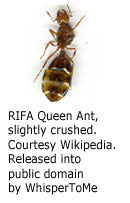 The red imported fire ant lives in a nest with a population of
several hundred thousand, including, often, a single queen that functions essentially
as an egg-laying machine; sterile and wingless female worker ants that tend to
the queen, care for immature ants, excavate and maintain tunnels, hunt down and
retrieve food, and defend the colony; and fertile and winged female and male
ants that take to the air in mating flights after a rain. The ants of a nest
recognize each other by a distinctive smell.
The red imported fire ant lives in a nest with a population of
several hundred thousand, including, often, a single queen that functions essentially
as an egg-laying machine; sterile and wingless female worker ants that tend to
the queen, care for immature ants, excavate and maintain tunnels, hunt down and
retrieve food, and defend the colony; and fertile and winged female and male
ants that take to the air in mating flights after a rain. The ants of a nest
recognize each other by a distinctive smell.
After mating - and on the breath of a wind that may carry her for miles - a young female turns to the business of establishing her own kingdom, although her chances of success are extremely small. She excavates a burrow. She sheds her wings. She lays her first eggs, which hatch within 7 to 10 days. She raises her first brood alone, feeding them infertile eggs and her own saliva. As her offspring mature and assume adult responsibilities, she turns to her primary role of laying eggs. After several years, the queen dies, signaling the end of the nest. A red imported fire ant queen can live up to 7 years. Worker ants may live 30 to 180 days depending on if they are minor workers, media workers or major workers.
Taxonomy of the RIFA
Kingdom -- Animalia -- All animals
Phylum -- Arthropoda -- Animals that have exoskeletons, segmented bodies and
jointed legs; includes insects, scorpions, spiders,
centipedes, many others
Class -- Insecta -- Animals that have three body segments and three pairs
of jointed legs; includes ants, termites, dragonflies,
cockroaches, many others
Order -- Hymenoptera -- Insects with biting jaws and four membranous wings;
includes ants, wasps, bees, sawflies, many others
Family -- Formicidae -- Ants, including more than 12,000 species
Genus -- Solenopsis -- 266 species of mound building, stinging ants with
segmented antenna
Species -- Solenopsis invicta -- Red imported fire ant
Aggressiveness
If a red imported fire ant colony is disturbed, the resident population erupts from its nest mound to attack the intruder - human or animal. Hundreds may swarm up the legs. Cued by a chemical signal, they lock their mandibles, simultaneously, into the flesh. They curl their abdomens into a stinging position. They drive their stingers home again and again. They inflict a pain much like a burn, giving the ants their name.
Fire ants may also storm anything that looks like food including people or children. RIFA infestations have led people to abandon recreational areas such as playgrounds, athletic fields, parks and picnic areas.
A Few Ant Facts
- Ants are attracted - for some unknown reason - to electrical fields. The ant infests water pumps, computers, air conditioners, and other electrical devices.
- The queen of a red imported fire ant colony can produce 1500 to 1600 eggs per day. She never leaves the nest. A healthy red fire ant queen can live up to seven years.
- The red imported fire ant, like other ants, can lift many times its own weight.
- Collectively, ants - like the human population - make up some 10 percent of the biomass of the earth.
- Fire ants both bite and sting. Only their sting contains venom and causes pain.
The information provided on this web site and by this web site through content provided by Authors or third party providers, and in other sources to which it refers, is PROVIDED FOR INFORMATIONAL PURPOSES ONLY and should not be used to diagnose or treat a health problem or disease.
Information provided at and by DesertUSA is NOT A SUBSTITUTE FOR PROFESSIONAL MEDICAL CARE. If you have a medical concern, or suspect you have a health problem you should consult your primary doctor or specialist.
If you cannot agree to this Health and Medical Disclaimer, you are not permitted to use this web site and should exit immediately.
Fire Ant
Velvet Ant
Ant Keepers “Pet” Ants
Harvester Ants
Discover The World Of Insects
Desert Animals & Wildlife
Links to Info. About Insects & Spiders
Related DesertUSA Pages
- How to Turn Your Smartphone into a Survival Tool
- 26 Tips for Surviving in the Desert
- Death by GPS
- 7 Smartphone Apps to Improve Your Camping Experience
- Maps Parks and More
- Desert Survival Skills
- How to Keep Ice Cold in the Desert
- Desert Rocks, Minerals & Geology Index
- Preparing an Emergency Survival Kit


Share this page on Facebook:
The Desert Environment
The North American Deserts
Desert Geological Terms


