Rock Squirrel
Spermophilus variegatus
Physical Characteristics and Habitat
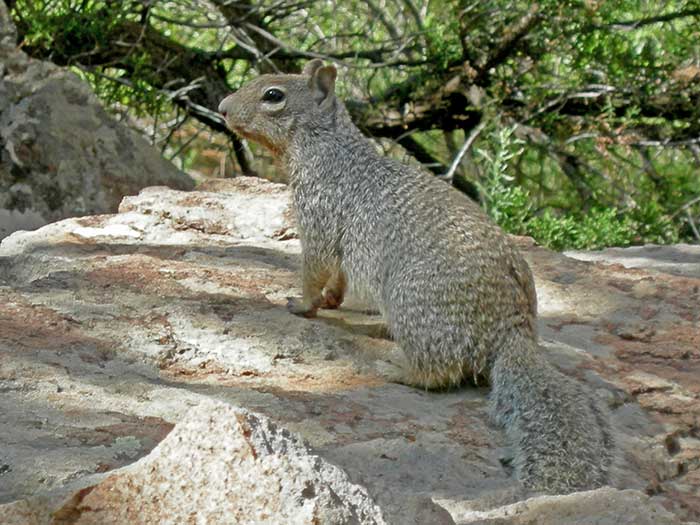
Rock squirrels are one of the largest members of the Scuridae family, growing to nearly a foot in length, not including their long, bushy tails which are nearly as long as their bodies. In front and on top, their coat is a speckled grayish-brown; in the back, and on the bottom the gray becomes a more mottled brownish black tone. They have a marked light colored ring around their eyes, and pointy ears that project well above their heads. When alarmed they whistle a short, sharp oscillating call.

They are found in the Sonoran Desert, and from Southern Nevada, Utah, Colorado, Oklahoma, and south through Arizona, New Mexico and into Mexico. Rock squirrels live in arid canyons, rocky cliff areas, and boulder piles, but have also been known to burrow in urban or suburban areas under lumber piles or junk cars. They avoid open flats and montain forest areas.
Video
Burrows and Behavior
Burrows dug with their sharp claws and muscular legs shelter them, providing safety, living space and food storage. Burrow systems can be complex and lengthy, enlarged over years. Entrances are usually hidden beneath rocks and can be greater than 3 inches in width. Rock squirrels in the northern reach of their habitat hibernate in their burrows during the colder months of the year. In southern areas, rock squirrels may not hibernate at all. They are active in the early morning and late afternoons when it is warm - when very hot, they may estivate. They are social, and live in colonies with several females and one dominant male that will fight other mature males to protect the group. There may be subordinate males at the outer boundaries of the group.
Rock squirrels can climb nearly as well as tree squirrels. They have been seen at the tops of agaves, junipers and mesquites, feeding on flowers, buds and beans.

In some areas they are considered a pest, as they eat crops. At Tonto National Monument in Arizona, their burrows have damaged some archaeological artifacts. Rock squirrel bones have been found in the earliest Salado ruins there though, so perhaps this squirrel was there before the people arrived.
Rock Squirrel Classification |
|
Kingdom: |
Animalia |
Phylum: |
Chordata |
Subphylum: |
Vertebrata |
Class: |
Mammalia |
Order: |
Rodentia |
Family: |
Sciuridae |
Rock Squirrel Vital Stats |
|
Weight: |
up to 1.5 lbs |
Length: |
Body 10-12"; Tail 8" |
No. of Young: |
3-9 young |
Mating Season: |
Early spring |
Gestation: |
30 days |
Birth Interval: |
sometimes two litters per year, first from March-June, second Aug-Sept |
Lifespan: |
1-2 years; report of 10 years in captivity |
Typical Diet: |
Omnivorous: seeds, insects, mesquite beans, fruits, carrion, small birds and eggs |
Predators: |
Hawks, roadrunners, coyotes, snakes, golden eagles, gray foxes |
Range: |
Southern Nevada, Utah, Colorado, Oklahoma, and south through Arizona, New Mexico and much of Mexico |
Hibernation period: |
6-8 months/Aug-Feb. though known to awaken on warm winter days; southern rock squirrels may not hibernate at all. |




Share this page on Facebook:
The Desert Environment
The North American Deserts
Desert Geological Terms


