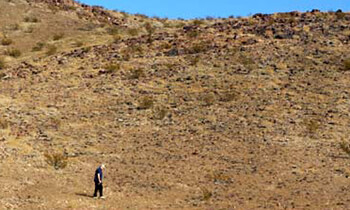
The Desert
The Desert Biome

Deserts cover more than one fifth of the Earth's land, and they are found on every continent. They can be classified as "hot" or "cold".
Cold deserts can be covered in snow or ice where the water is frozen. Examples of a cold desert are the Antarctic, Greenland and the Nearctic ecozone.
Hot deserts are generally warm throughout the year, and very hot in the summer. Deserts receive less than 10 inches of precipitation a year. In some hot deserts, the amount of evaporation is greater than the amount of rainfall.
Deserts of the United States
Deserts in the southwestern United States are areas of extreme heat and dryness, just as most of us envision them. The deserts in the United States and northern Mexico are grouped into four distinct categories.
- The Chihuahuan Desert is the largest desert in North America, covering more than 200,000 square miles.
- The Great Basin Desert is the largest desert within the borders of the United States (USA) and it covers an arid expanse of about 190,000 square miles.
- The Mojave Desert is an arid region of southeastern California which extends into portions of Nevada, Arizona and Utah, occupying more than 25,000 square miles.
- The Sonoran Desert is an arid region covering about 120,000 square miles in southwestern Arizona and southeastern California, as well as most of Baja California.
- Learn about Sand Dunes - Sand dunes occur throughout the world, from coastal and lakeshore plains to arid desert regions.
- Glossary - Desert and Geological Terms
Deserts of the World
- The Sahara Desert: Geology and Climate - One of the most storied and unforgiving lands in the world, the Sahara -- the Arabic word for "desert" -- evokes a poignant sense of time and nature's power, of antiquity and legend, of wonder and mystery.
- The Sahara Desert: Wildlife and Culture
- The Gobi Desert: Location and Landscape - The Gobi, the fifth largest desert in the world, arcs across the borderlands of northern China and southern Mongolia.
- The Gobi Desert: Wildlife, Plants and Culture
- Australia's Great Sandy Desert: Geology and Climate - The Great Sandy Desert sweeps across northwest and central Australia. It contains two of the country's most famous parks, the Rudall River National Park and Uluru-Kata Tjuta National Park where the famous Ayers Rock is located.
- Australia's Great Sandy Desert: Wildlife, Plants and Culture
Desert Life
Lack of water creates a survival problem for all desert organisms, animals, plants and people. Below are links to information on how they exist within their desert environment.
- Desert Animals & Wildlife - Links to many animals you will find within the desert environment.
- Desert Animal Survival - It's a miracle that life can survive in the extreme conditions of the deserts. Learn about reptiles, mammals, birds, fish and amphibians that have adapted and, in fact, thrive in the harsh ecosystems of the deserts.
- Desert Plants & Wildflowers - The deserts are renowned for the annual explosion of vibrant spring wildflowers and succulent cactus that adorn their landscapes. Enjoy the beautiful colors and learn about the unique characteristics of the plants that live in the deserts.
- Wildflower Watch - Find out what's blooming in the deserts.
- Desert Plant Survival - To survive, desert plants have adapted to extremes of heat and aridity by using both physical and behavioral mechanisms, much like desert animals.
- Plants and Animals, How They Are Classified - For centuries, biological scientists have worked to classify organisms in a way that would help clarify relationships among species through time, and across different and constantly changing environments.
- Desert Food Chain in Depth - A food chain constitutes a complex network of organisms, from plants to animals, through which energy, derived from the sun, flows in the form of organic matter and dissipates in the form of waste heat.
- Desert Food Chain for the Young Student
- Need for Water in the Deserts - Learn what can happen in a desert basin where no more than a few inches of rain fall in a typical year; where dependable natural water holes and streams lie far apart; where summer daytime air temperatures can soar to well over 100 degrees Fahrenheit and the soil temperatures to well over 150 degrees; and where small-leaf, spiny, low-growing and widely scattered plants offer scant shade or comfort.
- Desert People & Cultures - For many centuries the desert has been home to human life, from ancient hunters and farmers, to the native cultures Euro-American explorers first recorded, to settlers and modern inhabitants who enjoy its warm, dry climate and stunning vistas. Throughout the desert regions, monuments and parks have been established to preserve the record of these ancient and historic peoples, including cliff dwellings, rock art, ghost towns and historic sites commemorating all manner of human endeavors, adventures and travails.
- Desert Survival for People - Learning to be part of the desert's ecosystem is the first step of desert survival. Our philosophy is not to fight the desert, but to become part of its ecosystem. Being prepared is an obvious benefit.
- Desert Environment & Geology - Learn about the rocks, minerals and gemstones that form our North American deserts.
- Water Resources in the Southwest
- Wildfires - In some instances in the chaparral shrublands of coastal California, wildfires trigger germination of various plant seeds.
- It's Fire Season and the Santa Ana Winds Are Lurking - The Santa Ana winds have fueled some of the largest wildfires including the Cedar Fire, Laguna Fire, Old fire, Esperanza Fire, Santiago Canyon Fire of 1889 and the Witch Fire.
- Seasonal Migrations - Seasonal migration is one of the most fascinating feats of the animal world. Although birds are often the most evident of the migrants, animals as small as pinhead-sized spiders and as large as blue whales migrate by land, air or water. Movements can range in length from less than a mile, for Eurasian milkweed bugs, for example, to the incredible 25,000 miles per year of the arctic tern. Migrations may only be seasonal or may take a lifetime to complete.
- Dust Devils - Video - The dust devil is a rapidly rotating column of air that has wrapped itself around a rising thermal. The average dust devil is ten to 50 feet in diameter.
What is a desert?
Learn more about a desert.
Desert Food Chain Video
Videos of Desert Animals ![]()
Other DesertUSA Resources
Gem Trails Guides Books
Related Books & Gifts - Trading Post
Desert Rocks, Minerals & Geology Index
Desert Survival Primer
Desert Survival Kit
DesertUSA Newsletter -- We send articles on hiking, camping and places to explore, as well as animals, wildflower reports, plant information and much more. Sign up now. (It's free.)
The Desert Environment
The North American Deserts
Desert Geological Terms
SEARCH THIS SITE
View Video about Dust Devils. Born of the battle between the sun and sand, the dust devil is a rapidly rotating column of air that has wrapped itself around a rising thermal. The average dust devil is ten to fifty feet in diameter. The chief ingredients for a good dust devil are clear skies, a bright sun, and a dry hot surface. Click here to view video.
Desert Food Chain Video - A food chain constitutes a complex network of organisms, from plants to animals, through which energy, derived from the sun, flows in the form of organic matter and dissipates in the form of waste heat. The food chain’s biological productivity and species diversification depend on factors such as the daily duration and angle of seasonal sunlight, the timely availability of water, the daily swings of seasonal temperatures, the chemical content of the soils, and the availability of nutrients.
Watch Video
___________________________________
___________________________________
Take a look at our Animals index page to find information about all kinds of birds, snakes, mammals, spiders and more!
___________________________________
Click here to see current desert temperatures!
DesertUSA is a comprehensive resource about the North American deserts and Southwest destinations. Learn about desert biomes while you discover how desert plants and animals learn to adapt to the harsh desert environment. Find travel information about national parks, state parks, BLM land, and Southwest cities and towns located in or near the desert regions of the United States. Access maps and information about the Sonoran Desert, Mojave Desert, Great Basin Desert, and Chihuahuan Desert.