Ghost Towns and Desert Dreams
Terlingua, Texas and More
by George Oxford Miller
A ghost mining town booms and a four-star resort hopes to strike it rich
in West Texas on the border with Mexico -
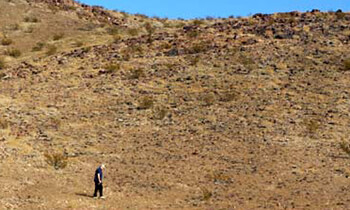
With a slight breeze cooling our faces and the morning sun warming our backs, my horse gave a little spurt and powered up the rocky slope. The woody stalks of lechugilla – or "lechu-get'cha" as locals call the spiny plant – cast long shadows across the hardscrabble landscape. Prickly pears and creosote bushes dotted the sandy arroyos and worn-down hills. In the distance, the Chisos Mountains in Big Bend National Park floated on the horizon like a purple cloud.

"This country was made for horseback riding," Richard Hill, our wrangler, said when we caught up. "I fell in love with it when my wife and I first visited back in the seventies. When I retired, I ask her where she wanted to live. 'Big Bend,' she said without hesitating. The first thing we did was get horses."
Similarly, the first thing my wife and I did when we got to Lajitas was sign up for a horseback ride. This landscape begs to be explored. Arroyos disect the desert flats and sheer mesas and mountains rise like petrified waves from the Cretaceous seabed. Besides, we had spent three days in the Big Bend National Park hiking 35 miles of trails, so riding a horse for a change was particularly appealing.

Lajitas, historically a trading post and fort, stands at the site of a ford where a branch of the Comanche War Trail crossed the Rio Grande. Today, the tiny community rubs shoulders with Big Bend National Park, with almost a million acres of desert, mountains and canyons to the east, and with Big Bend Ranch State Park, with its 280,000 acres of wilderness, to the west. The Rio Grande and the sparsely populated Mexico borderlands lie to the south. We could ride for days without crossing a paved road.
When Pancho Villa started raiding border communities in 1914, the U. S. Cavalry built a post in Lajitas and put it under the command of General "Black Jack" Pershing. Today, the post’s 26-room barracks is part of the Lajitas Golf Resort with a golf course, a spa, fine dining and an equestrian center. Real estate visionary Steve Smith bought the 23,000-acre "town" from its previous owner and rebuilt the resort, making it a four-star facility.
The solitude of the desert sets well with certain souls. Terlingua Ranch, on the highway to Alpine, sold its ten-acre ranchettes a decade ago, and Study Butte, a crossroads town at the park entrance, has grown to include motels, RV parks, cafes and rock and craft shops. Still, Big Bend National Park remains one of the most remote and least visited parks in the country.
West Texas has a history of attracting adventurers, fortune hunters, dreamers and people just wanting to escape the constraints of an eight-to-five society. Those who bought home sites in Lajitas have for neighbors the rattlesnakes, jackrabbits and javelinas, along with about 58 people in the booming ghost town of Terlingua. That's up from 25 people in 1990.
Terlingua, once the richest mercury-mining district in North America, boasted a population of 1,500 back in 1936. The quicksilver played out and the miners moved on to richer claims. New settlers renovated some of the rock and adobe houses scattered across the hills, but weather and time have reduced most to rubble.

To learn more about the glory days of the mining era, we booked a Jeep tour with Texas River and Jeep Expeditions. Angie Miller, a middle-aged woman with shoulder-length silver hair, picked us up in Lajitas. We turned off the pavement and headed down a pair of ruts to the old Lonestar Mine. Angie shifted into four-wheel drive and ground up a boulder-strewn switchback to the top of a narrow mesa.
 "This is Terlingua Ridge," she told us. "The limestone rocks are filled with ammonites and other fossils. The mercury-bearing ore, or cinnabar, runs in red veins between the strata." We walked over to a vertical shaft, covered with a metal grate, wide enough to swallow a half-dozen SUVs. "This ridge is honeycombed with tunnels," she said. "We have 23 miles of shafts underneath Terlingua."
A little farther along the ridge, we stop at a sprawling stone building with no roof. Several long-abandoned vehicles lie to the side. Clumps of cacti decorate the rusted hulk of an International pickup. Dozens of bullet holes riddle a late 1940s era Plymouth sedan. "That's Bonnie and Clyde's car," Angie jested.
The mountainside view from the stone building stretched deep into Mexico. "This was the machine shop for Lonestar Mine," Angie said. "Don't you think it would make a great dance hall? I love to dance. I'm going to buy it when I win the lottery."
For some reason, dreams, whether by prospectors, real estate developers or dance queens, come easy in the desert. Maybe the expansive vistas and the uninterrupted silence free the mind from constraining notions.
We gazed out across the vista. Rows of mountains reached to the horizon. "We have about 85 miles of visibility, today," Angie said. "On good days you can see 150 miles, but we don't get that very often any more. Too much pollution drifting up from petrochemical plants on the Texas coast and power plants in Mexico."
Angie pointed out the Christmas Mountains and Black Mesa. "That triangular peak over there is Hen Egg Mountain. One of the local strange-and-crazies believes it's a UFO base. The top lifts up so the spaceships can go in and out. He says they've given him a ride twice."
I asked her about the "chupa cabra," a mythical desert creature I'd heard about. "It's the size of a dog and sucks blood from goats, or any other creature," she said. "It looks like a black dog, but when it turns just right you can see its wings."
She paused when I asked her if she had ever seen one. "Once or twice, I think, in my headlights."

The view across the bleached slopes gave little hint of the present century. Weathered wooden crosses stood askew in the old cemetery, and the scars from mine tailings on Terlingua Ridge seemed as fresh as they must have a century ago. The dusty, rutted streets and cactus-studded landscape held tightly to the ghost-town aura. Come night, it wouldn't take much imagination to see a chupa cabra ducking behind one of the crumbling walls.

More Information
For jeep and canoe trips, contact Texas River and Jeep Expeditions at 1-800-839-RAFT, www.texasriver.com. For information on Big Bend National Park, see www.nps.gov/bibe, 1-432-477-2251.
Lajitas is located on Highway 170, 17 miles from Study Butte and the western entrance to Big Bend National Park, or 60 miles southeast of Presidio on Highway 170. The closest city is Alpine, 95 miles to the north, on Highway 118.
Hotels/Motels
Chisos Mountain Lodge is operated by Forever Resorts under special user permits from the USDA Forest Servic.
Click here for information on Lajitas Golf Resort.

Other stories about the area:
Searching for El Dorado - Río Grande River




Share this page on Facebook:
The Desert Environment
The North American Deserts
Desert Geological Terms


