
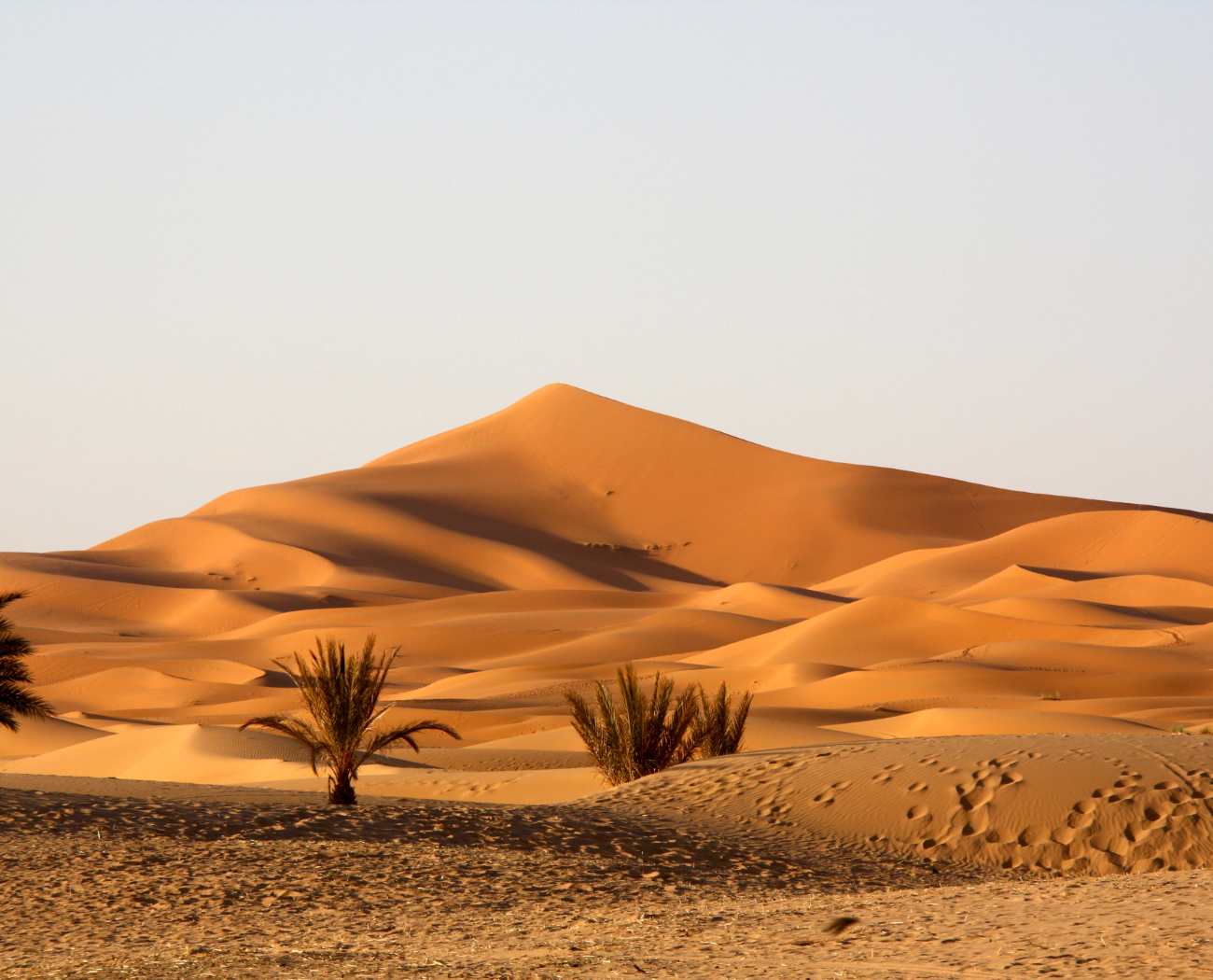
In the stillness of the desert, where the winds whisper ancient tales, the Sahara stretches her golden sands as far as the eye can see. She is a silent witness to the eons, her dunes shaped by the breath of time. However, considering her empty would be a mistake, for the Sahara—this vast ocean of sand—is brimming with secrets, life, and wonders that defy the imagination

A Desert of Extremes
According to Wikipedia, the Sahara is a land of superlatives: it is the third largest hot desert in the world and covers “9 million square kilometers (3,500,000 sq mi)”. It encompasses an area as large as the United States yet is home to only two million souls, a testament to its inhospitable nature. The relentless sun blesses the Sahara with up to 4,000 hours of sunlight a year, and temperatures soar to highs that can only be described as scorching, once reaching 47 degrees Celsius (116 degrees F). Despite these extremes, the Sahara is not a barren wasteland—it teems with life, each species a marvel of adaptation.
The Cycle of Life and Climate
The Sahara has not always been the arid expanse we know today. Her story is transformed as she has morphed from fertile lands to dry sands over thousands of years. This remarkable shift is part of the Sahara’s cyclical nature, driven by North African climate cycle changes. Over hundreds of thousands of years, the Sahara has oscillated between wet and dry periods due to the altering path of the North African Monsoon, usually southward, triggered by a 41,000-year cycle in Earth’s tilt, varying between 22° and 24.5°. Remarkably, in about 15,000 years, the Sahara is predicted to don the cloak of a savannah grassland once again, continuing the cycle of life that has defined this region since time immemorial.
More Than Just Sand
Contrary to popular images of endless dunes, the Sahara is mostly a rugged plateau. The sand seas that captivate photographers make up a mere 30% of her terrain. This rocky landscape, hamadas, dominates the desert, with sand dunes, gravel plains, and salt flats completing the mesmerizing mosaic.
Where Rain is a Rarity
In this kingdom of sands, rain is a rare and precious event. Some regions are so dry that they see less than a millimeter of precipitation annually, rivaling the dryness of the famed Atacama Desert. Nevertheless, even here, life finds a way to endure and even flourish.
The Heat Underfoot
One would think the air is the hottest part of the Sahara, but the sands beneath can become even hotter, recorded at a blistering 83.5 degrees Celsius (182.3 degrees F) near Port Sudan. Such temperatures make the Sahara’s sands a testament to the desert’s extreme nature.
Life Amidst the Dryness
The Sahara’s true marvel lies in its biodiversity. The Sahara’s flora encompasses a rich diversity of approximately 2,800 species. In contrast, despite its vast expanse, the central Sahara hosts a relatively low number of plant species, estimated at around five hundred. From the fabled Saharan silver ant, renowned as the fastest of its kind, to the resilient dromedary camels, fennec foxes, gazelles, cheetahs, and the enigmatic Deathstalker scorpion, each creature has evolved ingenious ways to survive in the unforgiving landscape of the Sahara. These remarkable adaptations underscore the desert’s awe-inspiring biodiversity and its inhabitants’ tenacity.
An Underground Lifeline
Beneath the Sahara’s parched surface lies a network of hidden rivers, giving rise to oases that dot the landscape like emeralds. These natural havens, including the famous Siwa Oasis, Kufra Oasis, and Tamanrasset Oasis, are where life clusters, thriving on the water that breaks through from the underground reserves. In the heart of this arid expanse, these lush pockets sustain a diverse array of flora and fauna and provide respite and shelter for nomadic communities and travelers traversing the vast Sahara desert.

Whispers of Sand and Time
As the Sahara’s sands shift, they sometimes reveal ancient rock paintings, reminders that humanity once thrived here, adapting to the desert’s rhythms. These artifacts symbolize the Sahara’s place in our shared history.
A Desert of Nighttime Cold and Daytime Heat
While the Sahara is synonymous with heat, it is lesser known that the desert experiences significant drops in temperature at night, sometimes reaching freezing points. This diurnal temperature variation is one of the many contrasts that define this enigmatic desert.
In the Sahara’s Embrace
With her unforgiving climate and beguiling beauty, the Sahara continues to capture the hearts of all who tread her sands. She is a reminder of the Earth’s raw power and her ability to nurture life in even the most extreme conditions. The Sahara is not just a desert; she is a canvas of history, a testament to survival, and a keeper of untold stories waiting to be told.
Learn more about the Sahara Desert
Sahara – Landscape, Climate, Location, and More.
Sahara Life – Wildlife, Plants, People, and Cultures
Sources: Conservation Institute, Facts.net, Animal Stratosphere, Smithsonian Magazine, and SciTech Daily.