
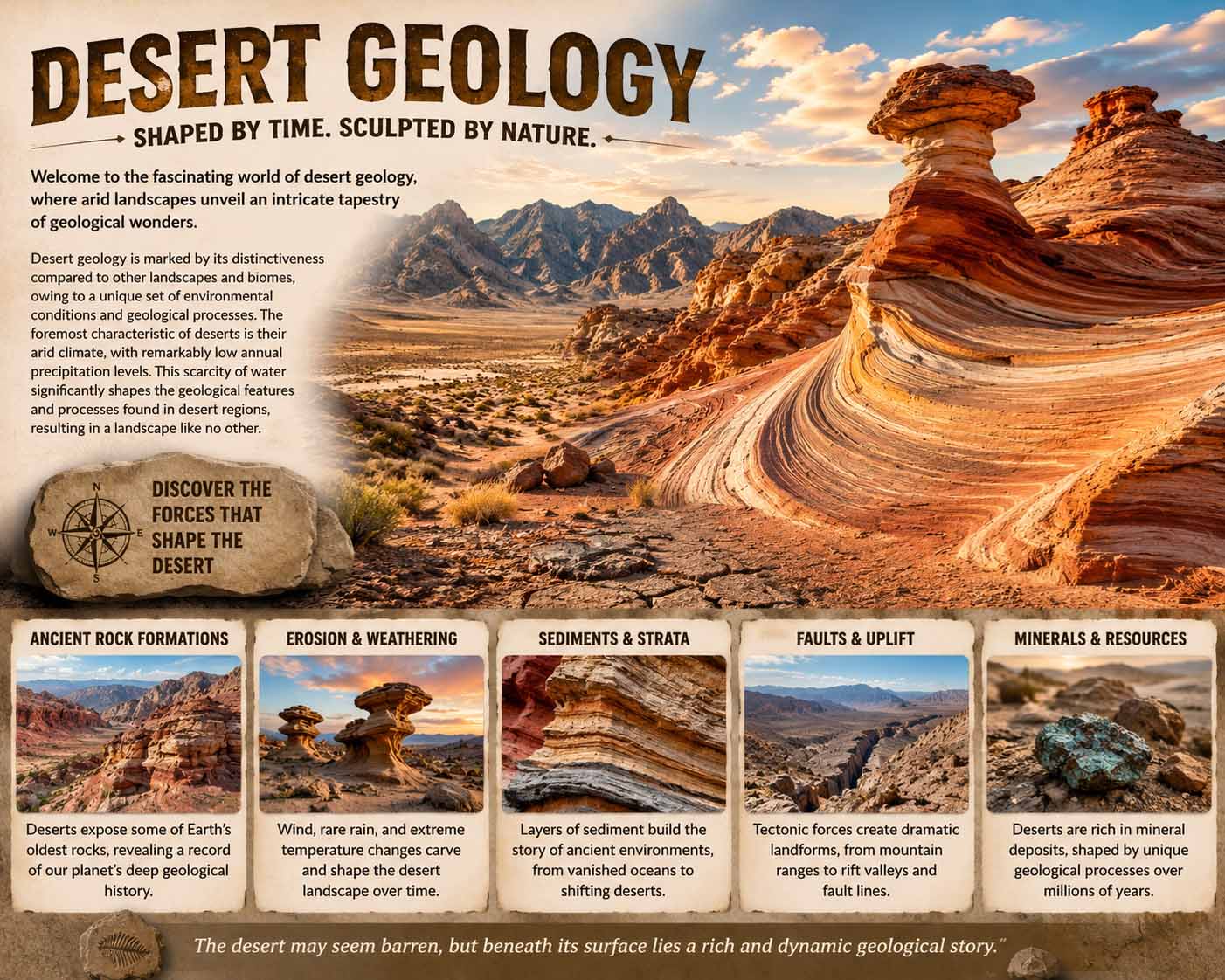
Desert Geology: How Water, Wind, Heat, and Time Shape the Desert
Desert landscapes may look dry and still, but geologically they are constantly changing. Wind moves sand, rare storms carve washes and canyons, temperature changes break exposed rock apart, and tectonic forces slowly raise mountains and reshape entire basins.
Desert geology is the study of the rocks, landforms, minerals, sediments, and geological processes found in arid regions. Because deserts receive little rainfall and often have sparse vegetation, their geology is unusually easy to see. Layers of rock that might be hidden beneath forests or soil in wetter climates can remain exposed across desert mountains, cliffs, badlands, and canyon walls.
The result is some of the most dramatic scenery on Earth: arches, hoodoos, mesas, canyons, dunes, dry lakebeds, volcanic fields, fault-block mountains, and vast expanses of exposed rock.
How Desert Landscapes Are Formed
Water may be scarce in deserts, but it remains one of the most powerful forces shaping them.
Short, intense thunderstorms can produce flash floods capable of moving enormous quantities of sand, gravel, boulders, and sediment. Over thousands or millions of years, repeated flooding can cut washes, arroyos, gullies, and deep canyons into the landscape.
Wind is another important force. It transports sand and fine sediment, polishes exposed rock surfaces, and creates dunes that can migrate across the desert.
Temperature also plays a role. Desert rocks may become extremely hot during the day and cool rapidly at night. Along with chemical weathering, freezing temperatures in some deserts, salt growth, and the expansion of minerals within cracks, these changes gradually weaken and break down exposed rock.
Together, weathering, erosion, transportation, and deposition continually reshape desert terrain.

Arches, Canyons, Hoodoos, and Other Desert Landforms
One of the most striking characteristics of desert geology is the variety of landforms exposed across arid regions.
Natural arches and rock windows form where erosion removes weaker portions of rock while more resistant sections remain.
Hoodoos are tall, irregular columns of rock produced when softer rock layers erode more rapidly than harder protective layers above them.
Canyons form as flowing water gradually cuts downward through rock and sediment.
Mesas and buttes are remnants of once-larger plateaus that have been gradually isolated by erosion.
Badlands develop where easily eroded sedimentary rocks and soils are carved into steep ridges, gullies, and colorful slopes.
Delicate Arch in Arches National Park is one of the best-known examples of erosion acting on desert sandstone.
The badlands at Font’s Point in Anza-Borrego Desert State Park demonstrate how water erosion can sculpt soft desert sediments into deeply dissected ridges and valleys.
Sand Dunes: Landscapes Created by Wind
Sand dunes form where wind transports loose sand and deposits it in areas where conditions allow the sand to accumulate.
Desert dunes are not all alike. Depending on prevailing winds, available sand, vegetation, and topography, dunes may develop into crescent-shaped barchans, long linear dunes, star dunes, transverse dunes, and other forms.
Although dunes may appear permanent, many are continually moving. Individual grains are lifted or rolled by the wind, gradually shifting the entire dune across the landscape.
Sand dunes provide one of the clearest examples of a desert landscape that can change noticeably within a human lifetime.
Playas, Dry Lakes, and Salt Flats
Many desert basins have no outlet to the sea. Water from surrounding mountains flows toward the lowest part of the basin, where it may temporarily collect in a shallow lake.
These temporary desert lakes are often called playas.
After the water evaporates, fine sediments and dissolved minerals remain behind. Repeated cycles of flooding and evaporation can create broad, flat surfaces covered with clay, salt, gypsum, or other mineral deposits.
Large desert salt flats are among the most recognizable results of this process.
Mountains, Faults, and Desert Basins
Not all desert features are created by erosion. Many originate deep within the Earth.
Tectonic movement can lift mountain ranges, create faults, produce earthquakes, and form large valleys and basins.
The Basin and Range region of the western United States is a dramatic example. Much of Nevada and parts of California, Arizona, Utah, and neighboring states consist of long mountain ranges separated by broad desert valleys.
As mountains rise and erode, rock and sediment wash into the surrounding basins. Over millions of years, enormous quantities of material can accumulate at the base of desert mountain ranges, forming features such as alluvial fans and bajadas.
Desert Rocks
Deserts expose all three major types of rock:
Igneous rocks form when molten rock cools and solidifies. Granite, basalt, and volcanic rocks are common in many desert regions.
Sedimentary rocks form from sediments deposited by water, wind, or other processes. Sandstone, limestone, shale, and conglomerate often preserve visible layers that record past environments.
Metamorphic rocks are older rocks that have been altered by heat and pressure within the Earth. Schist, gneiss, marble, and other metamorphic rocks occur in many desert mountain ranges.
Understanding these rock types helps geologists reconstruct the history of a desert landscape.
What Are Rocks?
Learn more about the three major rock groups:
Igneous | Sedimentary | Metamorphic
Rocks, Minerals, and Gemstones
North American deserts contain an extraordinary variety of rocks and minerals.
Mining districts throughout the Southwest have produced copper, gold, silver, borates, gypsum, salt, and many other mineral resources. Desert regions are also popular with rockhounds searching for agate, jasper, quartz, chalcedony, opal, turquoise, garnet, and other collectible materials.
Some minerals formed through volcanic and hydrothermal processes deep underground. Others accumulated when mineral-rich water evaporated from ancient lakes or desert basins.
The geology of each desert determines what can be found there, which is why neighboring desert regions may contain very different mineral deposits.
Explore:
Rocks | Gems | Minerals
Learn more about rocks, minerals, gemstones, and prospecting throughout the desert regions of North America.
Fossils and Ancient Desert Environments
Today’s desert was not always a desert.
Many arid regions contain sedimentary rocks deposited when the area was covered by ancient oceans, rivers, lakes, forests, or wetlands.
Fossils preserved within those rocks can reveal the plants and animals that lived there millions of years ago.
Marine fossils found high in present-day desert mountains may indicate that those rocks originally formed beneath an ancient sea. Fossil plants and animals can provide evidence of climates very different from the conditions found there today.
Because vegetation and soil cover are often limited, deserts are especially good places to observe exposed fossil-bearing rock formations.
Geology and Desert Life
Geology also influences where desert plants and animals live.
Rock type affects soil chemistry. Mountains influence rainfall. Canyons create shade and cooler microclimates. Springs may occur along faults or where groundwater reaches the surface.
Some plants grow mainly on particular soils or rock types, while animals use cliffs, caves, rock crevices, dunes, and washes for shelter and nesting sites.
The geology beneath a desert therefore helps shape the ecosystem above it.
What Is a Desert?
A desert is generally defined by its lack of precipitation rather than by temperature. Some deserts are extremely hot, while others experience cold winters and even snow.
The What Is a Desert and Desert Biome? section explains how deserts are defined, why they form, and how desert climates influence plants, animals, soils, and landscapes.
It is a good starting point for understanding the environmental conditions behind desert geology.
Geological Terms, Rock Formations, and Definitions
Explore the geological processes and formations that make desert landscapes so distinctive. Topics include erosion, rock formations, caves, dunes, sedimentary layers, minerals, and the forces that have shaped the deserts of North America over millions of years.
Related Desert Geology Articles
- Sand Dunes: Phenomena of the Wind!
- Life on the Sand Dunes
- Desert Caves & Caving (Speleology)
- Cave Features: Speleothems
- Minerals
From exposed ancient rock layers to moving sand dunes, desert geology tells a story stretching back hundreds of millions of years. Every canyon, mountain, dry lake, mineral deposit, and weathered rock formation provides another clue to the forces that created today’s desert landscape.