Desert Cactus
Cactus Flowers
by David Williams
As far back as I can remember, I have always liked cacti. Sometime in my sixth year, my parents gave me a small cactus with a flower grafted on to it. I was quite thrilled that this strange, spiny specimen had a flower. It seemed so exotic. During the following year, I faithfully watered my plant and tried to keep it in what little sun I could find in my Seattle bedroom. It didn’t exactly thrive. It didn’t die either, but I don’t remember that it ever grew and the flower finally dried and fell off. I eventually lost interest in this particular plant, but I never lost my interest in cacti.
I am still fascinated by cactus flowers; they are one of the great surprises and paradoxes of nature. How can such apparently defensive plants produce these magnificent blooms? They go to great lengths to protect themselves from predators with their spines and yet, each spring they create a clarion call announcing themselves. The showy brilliance of the flowers, an adaptive strategy to attract pollinators, contrasts with the dull green stems and pads; the instinct for reproduction competes with the need for survival.
About a mile from where I grew up was a small conservatory that had a fabulous collection of cacti. When I first discovered the succulent room I reveled in the sizes and shapes. WOW! Cacti taller than I (not that this said much, as I was only 4 feet tall). I visited the cacti room numerous times over the years, but I never saw a cactus bloom.
You always remember the first time. For me, my first cactus bloom in the wild came on a trip to Utah in 1987, fifteen years after I had nurtured my little cactus. I was with a group of friends in Canyonlands National Park. We had hiked down to the Colorado River to swim. About 200 yards from the river I spied it, a yellow flower on a green pad. It was beautiful. I was ecstatic: another childhood myth had been proven wrong, cactus could naturally bloom. Coincidentally, the plant I was so happy to see, the plains prickly pear, Opuntia polyacantha, also grows in my home state of Washington.
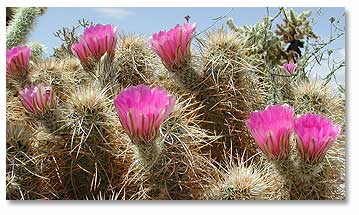
Cacti bloom in a wide spectrum of colors but specialize in the hues of sunset. Rose. Salmon. Pink. Yellow. Each spring the flowers burst forth from the areole, an organ found only on cacti. It is usually a solitary bloom, which lasts only a few days or weeks. During that time period it may be pollinated by bees, hummingbirds, or moths, some species of which have co-evolved to pollinate only one particular species of cactus. The often edible fruit appear after pollination and remain on the plant far longer than the flower.
I have a couple of spots I return to each year to see the cactus bloom. I especially look forward to seeing the return of the claret cup cactus, whose flowers seem to glow with a unique intensity. As spring progresses I keep watch for the profusion of scarlet flowers that emerge from the cluster of hedgehog shaped cactus. Although I have seen hundreds of cactus bloom, I am still amazed that cactus produce such a wonderful flower; it is one of the great delights of the desert.
While the flowers are the cactus' most impressive feature, its spines are probably the best known . They are an adaptation to desert living, where every drop of water is precious. Spines are modified leaves that release less moisture than normal leave.s They also prevent dessication by providing additional shade and restricting wind flow across the plant’s surface. And they are a superb defense mechanism against animals that want to eat a cactus’ fleshy pad or stem.
Most spines are short, sharp and hard, but they can grow in a variety of shapes and sizes. Some cacti have long, thin spines that cover the plant in a gray beard, while others look like red fish hooks or strange insects. The smallest hair-like spines (glochids) may not be noticed until one reaches out to probe a plant and discovers a finger full of tiny needles.
Spines also translate into a commonly encountered problem, poetically characterized as the "I don't enjoy a cholla" scenario. I have had this happen more than once, when I was walking along and a link of cholla seemed to leap from the plant and impale itself into my arm or leg. After many additional skewerings, I finally was told that the best way to deal with removal was to use a comb, preferabally one with a handle, and to slide it into the spines and lift out the cholla. The same person who told me this also recommended a fine way to remove glochids. He suggested putting rubber cement or Elmer's Glue on the minute spines, waiting for it to dry, and then peeling off the glue and the spines.
Sharp points, though, are not limited to cactus. Agave, yucca and ocotillo, all of which can skewer predators, are not in the cactus family. Another family of plants, Euphorbiacae, which is prevalent in Africa, has evolved along a similiar path and many of its species are practically impossible to tell apart from a cactus. Successful adaptations are usually widespread throughout the natural world.
I am not alone in my interest in cacti. The popularity of Santa Fe and the southwest has given rise to the use of saguaro as the symbol of this region. How many "Santa Fe" style restaurants use a saguaro in their logo and yet, saguaros neither grow near Santa Fe nor even in New Mexico. They are limited to the Sonoran desert of California, Arizona, and Mexico.

Unfortunately this interest in cacti has created a problem as collectors scour the deserts looking for exotic species. In many cases these cacti are then transported to an unsuitable habitat where they soon die. Numerous saguaro have been dug up to enhance suburban development projects, which contributes to a decline in the numbers of this unique plant in its natural environment. I understand the desire to have a cactus garden, but it is not necessary to destroy part of the desert to appreciate it.
One year ago a friend gave me a small cactus, which she had grown from a seed. I faithfully water it and it grows at a rapid pace. I have yet to see it flower, but spring is just around the corner and maybe I’ll get lucky with this plant. If not, I know where to go to see the cacti bloom in their native surroundings.
Editor’s Note: FOB (Friend of Bugs), freelance writer David B. Williams, author of A Naturalist’s Guide to Canyon Country.
Photo Tips
Most digital point-and-shoot cameras have a macro function - usually symbolized by the icon of a little flower. When you turn on that function, you allow your camera to get closer to the subject, looking into a flower for example. Or getting up close and personal with a bug. More on desert photography.




Share this page on Facebook:
The Desert Environment
The North American Deserts
Desert Geological Terms


