Colorado River Lake Levels, Water Temperatures
April 2026
The Colorado River is the lifeblood of the desert Southwest—carving canyons, powering cities, and creating some of the region’s most popular recreation lakes. Along its path lie Lake Powell, Lake Mead, Lake Mohave, and Lake Havasu—each formed by monumental dams and offering endless opportunities for outdoor fun.
Whether you’re boating, fishing, swimming, or camping, these lakes draw millions each year with their warm waters, stunning scenery, and year-round sunshine. This page provides real-time lake levels and water temperatures, so you can plan your trip with confidence—whether you’re launching a boat or just looking to cool off.
Explore the best ways to enjoy the Colorado River’s lakes—right here in the heart of the American Southwest.
Boating Supplies - Water Filters - Water Straws to purify drinking water
Click on the links below for more information on each lake.


Lodging Where to Stay - Boating
Water Level and Temperature
Water level up to 33.4% full
Water temp 59+

Lodging Laughlin, NV - Bullhead City, AZ
Water Level and Temperature
Water level 96% Full
Water temp 59+

The Colorado River, a crucial water source for over 40 million people across seven U.S. states and Mexico, is facing significant challenges in sustaining its supply to downstream cities, agricultural regions, and water bodies like the Salton Sea. The original 1922 Colorado River Compact allocated water rights based on overestimated flow measurements, leading to commitments that exceed the river’s actual capacity. This overallocation has been exacerbated by prolonged droughts and climate change, resulting in diminished water levels in major reservoirs such as Lake Mead and Lake Powell.
The long-term outlook for the Colorado River is concerning. Studies indicate that the river’s flow has declined by approximately 20% over the last century, with projections suggesting further reductions of up to 31% by 2050. This decline threatens the water security of major urban centers, agricultural operations, and ecosystems dependent on the river. The Salton Sea, for instance, relies heavily on agricultural runoff from Colorado River water; reduced flows could accelerate its shrinkage, leading to environmental and public health issues. Addressing these challenges requires revisiting existing water allocation agreements, implementing more efficient water use practices, and developing adaptive strategies to cope with the anticipated decrease in water availability.
Boating Supplies - Water Filters - Water Straws to purify drinking water
The Colorado River is shrinking, and the Southwest is running out of time. This video explains why the river is drying up, who’s affected, and what solutions may still be possible before it’s too late.
Lake Powell
Lake Powell is projected to intersect critical thresholds by mid‑2026, with hydropower at risk and emergency operations plausible under drier conditions. According to forecasts, Lake Powell may fall below 3,525 ft as early as April 2026 in the most probable scenario—this threshold would trigger emergency drought response operations .
In a drier scenario, elevations could drop below 3,490 ft by December 2026, which would lead to hydropower generation ceasing entirely at Glen Canyon Dam.
📊 Year-end estimates Under the most probable scenario, the January 1, 2026 elevation was projected at 3,534.4 ft, with storage in the Mid-Elevation Release Tier releasing 7.48 MAF during WY 2026. Actual level at that date was 3538 Monthly projections for WY 2026 inflow: most probable ~8.00 MAF, minimum and maximum bracket uncertain but notably lower or higher respectively .
🧠 Broader Context: Climate & Basin Conditions The Colorado River Basin continues to face a “megadrought” dating back nearly 25 years. Climate warming and persistent low snowpack have suppressed flows by about 13% over the long term. Groundwater depletion has surged—nearly 27.8 million acre-feet of groundwater lost since 2003 across the region
Water Elevation Lake Powell By Month
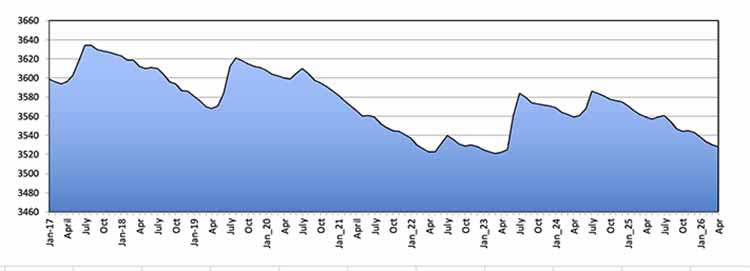
Chart by year from 1998 to 2026

Lake Powell is down 31.18 Feet from one year ago.
Water releases from the Glen Canyon Dam fluctuate based on power needs, which can sometimes leave downstream river users high and dry - literally! Generally, less water is released on Sundays. The Colorado River provides water for 40 million people across the Southwest.

Road Conditions Check for updates
The public is asked to use extreme caution when using the public launch ramps at Lake Powell. Most of the main boat ramps are open. The deepest launch ramp at Lake Powell continues to be Wahweap main ramp. Different boat/trailer combinations require varying depths of water, so remember to assess the water depth for your boat before launching.
Due to significant wind damage and low water conditions, Dangling Rope Marina is closed until further notice. The damaged docks are not safe for visitors or employees.
Hite retail store, pay-at-the-pump fuel service, the visitor comfort station, and designated camping areas will be closed. Public restrooms at the Hite Ranger Station, fresh drinking water spigot and RV dump are open. Plan your fuel use ahead.
New Tiered Boat Pass fees begin Monday, March 4, 2024. The passes will better align a fee structure that will reflect costs associated with the needs of vessels utilizing Lake Powell.
7/15/2024 Stateline Main Launch Ramp Temporarily Closed
The Stateline Main Launch Ramp is temporarily closed to accommodate staging for vessel salvage operations. Stateline Auxiliary Ramp remains open.
The lake level is changing every day: keep alert!
More information on changing lake levels
Lake Mead
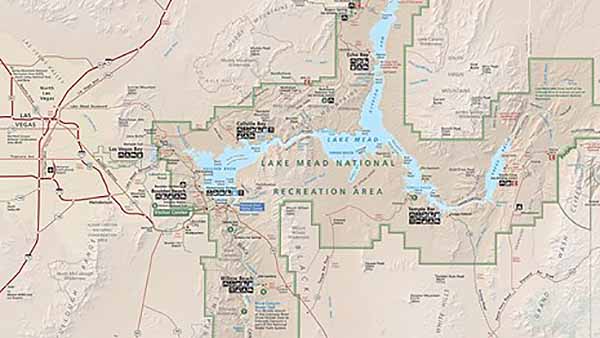
Lake Mead is down -2.00 feet from one year ago.


Current Status (as of late March/early April 2026)
- Lake Mead's water surface elevation stands around **1,062–1,065 feet** above sea level (with minor day-to-day fluctuations and slight seasonal rises reported in some early 2026 observations).
- The reservoir is approximately **34% full**, holding about 8.8 million acre-feet of water.
- This remains well below the long-term average and far from full capacity (1,229 ft), but it is higher than the record low of **~1,040.6–1,041 ft** reached in July 2022.
The lake has experienced gradual declines over recent years amid ongoing drought conditions, low snowpack/runoff into the Colorado River system, and high demand, though short-term fluctuations occur due to seasonal inflows, releases from Lake Powell, and conservation efforts.
Updated USBR Predictive Forecasts
The USBR's monthly **24-Month Studies** (most probable scenario) and related analyses provide the following outlook:
Short-term (2026): Lake Mead is expected to continue declining and is projected to fall **below 1,050 ft** at some point in 2026 (potentially by mid-to-late 2026 in earlier 2025-based projections). This would trigger a **Tier 2 shortage** under the Lower Basin shortage guidelines (as amended). A Tier 2 shortage would impose greater reductions in water allocations, including an additional ~4,000 acre-feet per year reduction for Nevada beyond current Tier 1 cuts.
By mid-2027: Most-probable projections indicate the elevation could reach around **1,038 ft** or lower by June 2027 in some scenarios, with further drops anticipated later in the year.
- **Record lows**: Under the most probable scenario, the lake is increasingly likely to set **new record lows** (below the 2022 mark) by late 2026 or during 2027. Recent updates to the projections (e.g., March 2026 study and subsequent refinements) have worsened the outlook, with some end-of-2027 estimates (such as November) dipping as low as **~1,033 ft** — roughly 8 feet below the 2022 record low.
- **Drier-than-expected scenario**: In minimum/probable minimum inflow cases, levels could fall even further, approaching or nearing **1,026 ft** by late 2027. This would come close to the **Tier 3 shortage** threshold (below 1,025 ft), which triggers the most severe curtailments for Arizona, Nevada, and (to a lesser extent) Mexico.
Note that shortage tiers for a given year are formally determined in the prior August based on projected January 1 elevations. Lake Mead is currently operating under Tier 1 shortage conditions for 2026.
Broader Implications
Hydropower and infrastructure: Hoover Dam's power generation remains viable in the near term, as levels are still well above minimum power pool thresholds (~1,000 ft or lower, depending on operations). Dead pool (where water can no longer be released downstream) is not considered imminent.
Water allocations: Deeper shortages would mean escalating cuts to Lower Basin users. Nevada faces relatively smaller absolute reductions compared to Arizona, but any Tier 2 or higher declaration intensifies pressure on urban, agricultural, and tribal allocations. Additional conservation (e.g., via the Lower Colorado River Basin Conservation Program) is factored into models but may not fully offset low inflows.
Uncertainty factors: Projections depend heavily on snowpack, runoff into Lake Powell (which feeds Mead), temperatures, and evaporation. Recent winters have underperformed, leading to downward revisions in forecasts. Post-2026 operational guidelines for the Colorado River are still under negotiation, adding long-term uncertainty.
Overall, the situation remains concerning but not catastrophic in the immediate term. **Lake Mead** is likely to experience new record lows and more severe shortage tiers by late 2026 or 2027 under most-probable and drier scenarios, increasing risks of deeper water supply reductions. However, ongoing conservation, potential wetter years, and management adjustments (including coordinated releases from Powell) could moderate the decline.
For the most precise real-time data and latest 24-month study, check the USBR's Lower Colorado River operations page (usbr.gov/lc) or their hourly elevation tracker. Projections are updated monthly and can shift with new hydrologic data.
Boating Supplies - Water Filters - Water Straws to purify drinking water
Alerts & Conditions
Lake Mead Ramp Status --
Current Conditions at Lake Mead & Lake Mohave
The park is located in both Nevada and Arizona.
Please check with the most recent state orders before traveling.
Lake Mead NRA has transitioned to a cashless fee collection system, accepting only electronic card payments for entrance, lake use, and campground fees. Entrance stations will continue to sell passes only with credit card.
Most restrooms and stores are closed. Please bring everything you need, including water for you and your pets, and pack out everything you bring in.
Remember, Styrofoam and glass are never allowed in the park. Thank you for keeping your park clean and trash free.
Historic Railroad Trail Tunnel 3 Closed Until Further Notice Due to visible deterioration of the support beams within Tunnel 3 of the Historic Railroad Trail, this tunnel is closed, until further notice. Visitors may hike from the trailhead to Tunnel 3 and back. Access into the tunnel is prohibited.
Lake Mojave and the Colorado river
Multi-vessel/vehicle discounts are no longer offered - for latest fees see park website.
Public vehicle access to the shoreline at Boulder Harbor is no longer be available. The area is now the Boulder Harbor Walking Trail.

Laughlin on the Colorado river.
No one may operate a personal watercraft (PWC) that does not meet the 2006 emission standards set by EPA for the manufacturing of two-stroke engines. A person operating a personal watercraft that meets the EPA 2006 emission standards through the use of direct-injection two-stroke or four-stroke engines, or the equivalent thereof, is not subject to this prohibition and will be allowed to operate as described in this section.

Sunset Katherine's Landing South end of Lake Mohave
The NPS and Forever Resorts, LLC dedicated the first floating building project in the world to be registered for LEED® certification at Lake Mead National Recreation Area's Cottonwood Cove Resort and Marina on Lake Mohave.
The bridge over the Hoover Dam is open for traffic.
DesertUSA has videos on Lake Mead and Hoover Dam, Glen Canyon Dam, Lees Ferry, Rainbow Bridge, and Lake Mojave's Davis Dam and Laughlin, NV.
You can now experience the Colorado River via Google Street View.https://www.google.com/maps/about/behind-the-scenes/streetview/treks/colorado-river/
Take a virtual trip on Lake Mohave and the Colorado river in this DesertUSA video.
Lodging Laughlin, NV - Bullhead City, AZ
Send us your river stories and pictures to share with fellow river lovers. What else do you want DesertUSA to cover in our updates? Let us know. E-mail pictures and comments to Jim@desertusa.com

Glen Canyon Dam

Click on the picture above to read the story of the Hoover Dam Bypass Bridge,
named the Mike O'Callaghan-Pat Tillman Memorial Bridge.




Share this page on Facebook:
The Desert Environment
The North American Deserts
Desert Geological Terms


