Spineless Horsebrush
Tetradymia canescens
Color: Yellow
Common name: Spineless Horsebrush
Latin name: Tetradymia canescens
Family: ASTERACEAE
Height: 4-32 inches
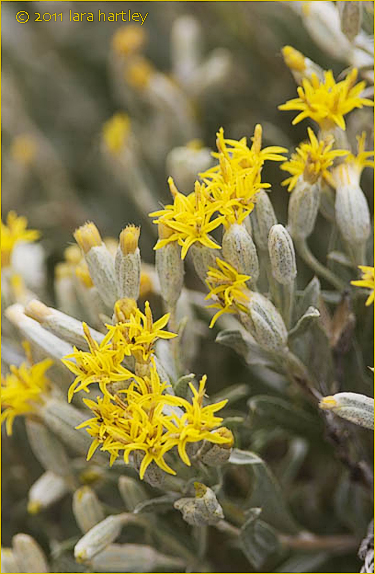
Description: Spineless Horsebrush is a bushy shrub with multibranched woody or semi-woody stems that grow from taproots. It is coated in woolly fibers with hairless strips at intervals along the branches. It has no spines. The inflorescence bears usually three to six flower heads which are each enveloped in four thick phyllaries coated in white woolly hairs. Each head contains four tubular flowers in shades of pale to bright yellow, each measuring up to 1.5 centimeters long.
Leaf: The lance-shaped leaves are no more than 4 centimeters long and woolly or silver-haired in texture. Longer-lived leaves are alternately arranged along the stem and smaller, shorter-lived leaves occur in clusters near the axils of the primary leaves.
Range: Mojave Desert, Transverse Ranges, s Peninsular Ranges, Great Basin Floristic Province
Habitat: Sagebrush scrub, pinyon/juniper woodland, forest
Elevation: (400)1600–3300 m.
Flowering time: Jul–Aug
Notes: The shrub is wildfire-resistant, resprouting vigorously and increasing in herbage and seed production in seasons following a fire. Fire suppression efforts decrease the abundance of the shrub and frequent burns increase it. The shrub is toxic to sheep, causing photosensitivity, bad wool quality, abortion, and death. It causes a swelling of the head known as bighead disease.
Native American groups used this plant for a number of medicinal purposes, including protection from ghosts and witches.
We have an online wildflower field guide that is designed to help you identify desert wildflowers by color, scientific name, region and common name. The pictures are sized to work on the iPod, iPhone, iPad and similar devices. With your iPod or phone you will easily be able to identify wildflowers while in the desert. Links for downloads are on the bottom of the Wildflower Field Guide page.
Photo tips: Most digital point-and-shoot cameras have a macro function - usually symbolized by the icon of a little flower. When you turn on that function, you allow your camera to get closer to the subject, looking into a flower for example. Or getting up close and personal with a bug. More on desert photography.
Mojave Desert Wildflowers - This book is the standard by which all other wildflower books are measured. The author, Jon Mark Stewart, has combined super photography with concise information. This book has an entire color page for each wildflower covered, with a discussion of the wildflower. 210 pages with 200 color photos. More...
What's Blooming Now - Check the Wildflower Reports
Related DesertUSA Pages
- How to Turn Your Smartphone into a Survival Tool
- 26 Tips for Surviving in the Desert
- Death by GPS
- 7 Smartphone Apps to Improve Your Camping Experience
- Maps Parks and More
- Desert Survival Skills
- How to Keep Ice Cold in the Desert
- Desert Rocks, Minerals & Geology Index
- Preparing an Emergency Survival Kit


Share this page on Facebook:
The Desert Environment
The North American Deserts
Desert Geological Terms


